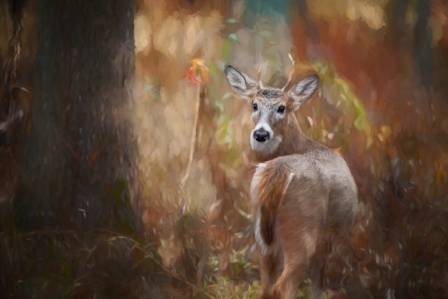
Deer have long been a favored subject for artists, featuring in paintings across history and diverse cultures. Admired for their beauty, elegance, and symbolic meaning, they’ve been portrayed in countless styles and mediums—from lifelike representations to abstract interpretations.
Deer paintings often evoke a sense of calm, as these creatures are frequently depicted in serene natural environments like forests or meadows. They can also convey strength and grandeur, as seen in artworks of stags with antlers raised in a display of dominance.
Famous deer paintings include works by artists such as Sir Edwin Landseer, Rosa Bonheur, George Stubbs, and Gustave Courbet, to name just a few. These pieces have become iconic examples of wildlife art and continue to inspire creators and audiences worldwide.
1. Deer in the Forest – Franz Marc
“Deer in the Forest I” is a celebrated work by German expressionist artist Franz Marc. Created in 1913, it’s part of a series where the artist explores nature’s beauty and vitality.
In the painting, Marc shows a group of deer in a lush woodland setting. The deer are rendered in bold, vivid hues that stand in contrast to the forest’s deep greens and browns. Marc was known for using color to express emotion and mood, and this piece is a perfect showcase of his expertise in that area.
The deer themselves are stylized, with elongated limbs and curved bodies. Marc drew influence from French painter Paul Cézanne, who sought to break away from traditional artistic representation. Like Cézanne, Marc was interested in exploring the underlying geometry of the natural world.
“Deer in the Forest I” is regarded as one of Marc’s most significant works and has become an iconic image of the German Expressionist movement.
2. The Wounded Deer – Frida Kahlo
“The Wounded Deer” is a well-known painting by Mexican artist Frida Kahlo, finished in 1946. It’s a self-portrait depicting Kahlo as a wounded deer, pierced by arrows and bleeding—often interpreted as a symbol of her physical and emotional agony.
In the artwork, Kahlo’s head is replaced by that of a deer, with antlers emerging from her forehead. Her body is shown nude and vulnerable, with arrows penetrating her flesh. The background is a desolate landscape beneath a stormy sky.
Kahlo was famous for her deeply personal and emotional art, which often reflected her struggles with physical and emotional pain. She endured numerous health issues throughout her life, including polio as a child and a bus accident that left her with permanent injuries.
“The Wounded Deer” is one of Kahlo’s most renowned works, now part of the Museum of Modern Art’s collection in New York. It has become a powerful symbol of resilience and strength in the face of suffering, continuing to inspire artists and viewers globally.
3. The Hunt in the Forest – Paolo Uccello
“The Hunt in the Forest” is a famous piece by Italian Renaissance artist Paolo Uccello, completed in 1470. It depicts a group of mounted hunters, accompanied by hounds and falcons, pursuing a stag through a forest.
The painting is notable for its dynamic composition and use of perspective. Uccello was among the first artists to employ linear perspective, and “The Hunt in the Forest” excellently demonstrates his skill in this technique.
It features a series of converging lines that draw the viewer’s eye deep into the forest, creating a sense of depth and space. The figures are stylized, with elongated limbs and exaggerated gestures. Uccello’s interest in mathematics and geometry is evident in the precise, almost mechanical quality of his figures.
“The Hunt in the Forest” is considered one of Uccello’s most important works, now housed in Oxford’s Ashmolean Museum in England. It has become a classic example of Renaissance art, inspiring artists and viewers around the world.
4. The Vision of Saint Eustace – Annibale Carracci
“The Vision of Saint Eustace” is a celebrated painting by Italian Baroque artist Annibale Carracci, finished in 1615. It depicts the legendary tale of Saint Eustace, who was a Roman general named Placidus before converting to Christianity.
According to the story, Placidus was hunting one day when he saw a vision of a crucifix between a stag’s antlers. A voice told him he would suffer greatly for his faith but ultimately be saved. Deeply moved, Placidus and his family converted to Christianity, changing their names to Eustace and Theopista (his wife).
In Carracci’s painting, Saint Eustace kneels before the crucifix, with the stag and his family nearby. The composition is complex and dramatic, with movement and tension created by the figures’ placement and the use of light and shadow.
Carracci was known for creating grand, monumental works that blended classical art elements with the Baroque period’s drama and emotion. “The Vision of Saint Eustace” is one of his most significant pieces, now in Naples’ National Museum of Capodimonte. It has become an iconic example of Baroque art, inspiring audiences globally.
5. The Monarch of the Glen – Sir Edwin Landseer
“The Monarch of the Glen” is a famous painting by Scottish artist Sir Edwin Landseer, completed in 1851. It shows a majestic stag standing proudly on a rocky outcrop in the Scottish Highlands.
The work is notable for its dramatic composition and meticulous attention to detail. Landseer was renowned for his skill in rendering animals, and “The Monarch of the Glen” perfectly showcases his ability to capture nature’s grandeur and power. The stag is depicted in intricate detail, with its antlers and fur rendered realistically.
This painting has become an iconic symbol of Scottish culture and is widely recognized as one of the world’s most famous animal artworks. It has been reproduced in various forms, including on clothing, home décor, and even whiskey bottles.
In recent years, it has sparked some controversy, with critics arguing it romanticizes wild animal hunting. Others, however, contend it celebrates nature’s beauty and power and remains an important cultural icon in Scotland and beyond. It is now housed in Edinburgh’s National Museum of Scotland.
6. Red Deer Stag and Hind – George Stubbs
“Red Deer Stag and Hind” is a renowned work by British artist George Stubbs, finished in 1764. It depicts a pair of red deer—a stag and a hind—in a naturalistic landscape setting.
Stubbs was interested in anatomy and the natural world, and his paintings often focused on animals in motion. In “Red Deer Stag and Hind,” the animals are shown in lively, dynamic poses: the stag rears up on its hind legs, while the hind looks on attentively.
The painting is notable for its detailed rendering, with each animal carefully depicted to show its unique features and movements. The landscape is also highly realistic, with atmospheric perspective creating a sense of depth and space. It is now part of London’s Tate Britain museum and remains one of Stubbs’ most famous and influential works, an iconic example of British wildlife painting.
7. Landscape with Deer – Rosa Bonheur
“Landscape with Deer” is a famous painting by French artist Rosa Bonheur, completed in 1868. Bonheur was one of the 19th century’s most prominent female artists, known for her realistic depictions of animals and landscapes.
In “Landscape with Deer,” Bonheur shows a group of deer grazing in a picturesque setting. The work is notable for its attention to detail, with each deer carefully rendered to highlight their individual features and movements. The landscape is also highly realistic, with lush greenery and atmospheric perspective creating depth and space.
Bonheur was passionate about animals and the natural world, which often featured in her paintings. She was also a pioneer for women in the art world, achieving great success and recognition at a time when female artists were frequently overlooked.
8. Cheetah and Stag with Two Indians – George Stubbs
“Cheetah and Stag with Two Indians” is a celebrated work by British artist George Stubbs, finished in 1765. It depicts a leashed cheetah, held by two Indian men, chasing a stag through a naturalistic landscape.
Stubbs focused on animals and the natural world in his art, often exploring their anatomy and movements. In this painting, he captures the drama and excitement of a hunt, with the cheetah and stag shown in dynamic poses.
The work is notable for its meticulous detail, with each animal carefully depicted to show its unique features and movements. The landscape is also highly realistic, with atmospheric perspective creating a sense of depth and space.
9. Deer Running in the Snow – Gustave Courbet
“Deer Running in the Snow” is a famous painting by French artist Gustave Courbet, completed in 1861. It shows a lone deer running through a snowy landscape.
Courbet was known for his commitment to realism, and this work is an excellent example of his ability to capture nature’s beauty and power. The deer is depicted naturalistically, with its movements and expressions carefully observed and rendered.
The painting stands out for its use of color and texture. Courbet employed a thick impasto technique to create texture and depth in the snow and trees, and used a muted color palette to convey the cold, wintry atmosphere of the scene.
10. Fallow Deer – Richard Ansdell
“Fallow Deer” is a renowned work by British artist Richard Ansdell, completed in 1861. It depicts a group of fallow deer in a forest, with a buck in the foreground and several does and fawns in the background.
Ansdell was skilled in rendering animals, and “Fallow Deer” showcases his ability to capture the natural world’s beauty and power. The deer are depicted naturalistically, with their movements and expressions carefully observed and rendered.
The painting is notable for its use of light and color. Ansdell was a master of light and shadow, using these elements to create depth and atmosphere. In “Fallow Deer,” dappled sunlight filtering through the trees creates a sense of warmth and tranquility.