PL
pipilandbook.com
King Penguin

Shelf read

King Penguin

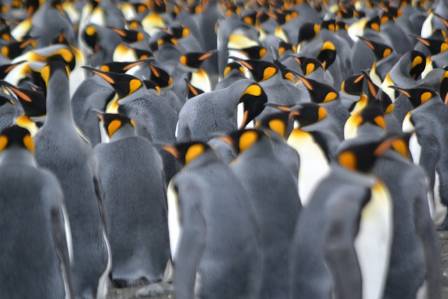
King penguins occupy a broad range across the sub-Antarctic region, forming large breeding colonies on islands scattered in a rough circle around the Antarctic continent. Their primary habitats include the Crozet Islands, Falkland Islands, Heard Island, Kerguelen Islands, Macquarie Island, Prince Edward Islands, South Georgia, and the South Sandwich Islands. These remote locations provide the cold but relatively stable environments that the species depends upon.

E

Ethan Miller

Library note

Reading tip

The full chapter continues below on the soft reading shelf.

Stack

Pocket Library

Geographic Range
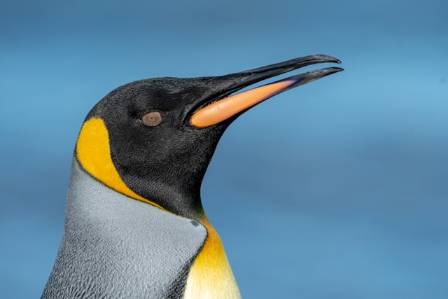
King penguins occupy a broad range across the sub-Antarctic region, forming large breeding colonies on islands scattered in a rough circle around the Antarctic continent. Their primary habitats include the Crozet Islands, Falkland Islands, Heard Island, Kerguelen Islands, Macquarie Island, Prince Edward Islands, South Georgia, and the South Sandwich Islands. These remote locations provide the cold but relatively stable environments that the species depends upon.
Although the species’ core population is centered within this ring of islands, isolated individuals have occasionally been recorded much farther afield. Non-breeding penguins are sometimes observed along the coasts of southern South America, including Chile and Argentina, and rare sightings have been documented as far north as Brazil and South Africa. Some wandering individuals have even reached the fringes of the Antarctic continental ice, far beyond their normal breeding range.
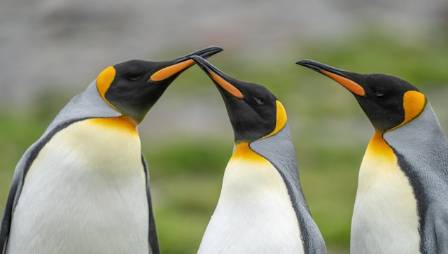
Two distinct genetic subspecies of king penguins are recognized. The first, Aptenodytes patagonicus patagonicus, is found exclusively on South Georgia and the Falkland Islands. Colony sizes in these locations vary widely, from about 9,000 to nearly 40,000 breeding pairs, depending on environmental conditions and available nesting space. The second subspecies, A. p. halli, inhabits several other sub-Antarctic island groups, including Crozet, Heard, Kerguelen, Macquarie, and Prince Edward Islands. Although their distributions are separated geographically, both subspecies share similar ecological requirements and behaviors, such as reliance on oceanic feeding grounds near the Polar Front.

Habitat

King penguins divide their lives between the open ocean, where they forage for food, and the shores of sub-Antarctic islands, where they breed and raise their young. Their terrestrial nesting sites are typically located on low, gently sloping beaches or coastal plains that are relatively free of snow and ice during the breeding season. These areas often have sparse or minimal vegetation, which makes them ideal for large colonies and allows adults to move easily between the sea and their chicks.
Most of the islands where king penguins breed are positioned just south of the Polar Front—a region where cold Antarctic waters mix with warmer sub-Antarctic currents. This location offers access to nutrient-rich waters teeming with fish and squid, which form the core of the penguins’ diet. Despite their proximity to the Antarctic, these islands generally remain outside the persistent pack ice zone, making them habitable throughout the year.
The physical landscapes of these islands vary considerably. For instance, Heard Island rises sharply to an elevation of about 2,745 meters and is dominated by glaciers and permanent snowfields. In contrast, islands such as Macquarie, which reaches roughly 433 meters at its highest point, have gentler topography and limited areas of tundra-like vegetation. During the winter months, many islands experience heavy snowfall, and bays or inlets may freeze over completely—especially on South Georgia, where ice can cover more than half the island during the coldest part of the year.
Vegetation in these environments is generally sparse due to the harsh climate. Where snow and ice retreat, the exposed ground supports mainly mosses, lichens, and a few hardy grasses. On some of the milder islands, such as Macquarie, small patches of ferns and flowering plants can be found, providing limited green cover in the summer months. Even so, the overall plant life remains minimal, creating the open terrain favored by nesting king penguins.
Climatic conditions across the sub-Antarctic islands are cold but relatively stable, with modest temperature differences between summer and winter. The average summer temperatures are usually only a few degrees above freezing, and strong winds and heavy precipitation are common throughout the year. These stable but chilly environments reduce the risk of overheating for penguins that spend much of their time on land during breeding.
When feeding, king penguins often travel considerable distances from their colonies, moving northward toward the warmer waters just beyond the Polar Front. Here, surface temperatures typically average around 4.5 °C, providing rich foraging grounds filled with small fish and squid. The species is an exceptional diver, capable of reaching depths of more than 300 meters—one record indicates a dive to approximately 322 meters. These deep dives allow them to exploit underwater prey sources unavailable to most other seabirds.
By alternating between these two worlds—land and sea—king penguins demonstrate remarkable adaptability. Their breeding grounds provide safety for raising chicks, while the vast surrounding ocean offers the sustenance they need to survive in one of the planet’s most extreme environments.

More on this shelf

CV

COVER · en

Ten Intriguing Realities of Semiconductor Technology

Ten Intriguing Realities of Semiconductor Technology

Semiconductors rank among the most significant breakthroughs in human history.

CV

COVER · en

5 Fascinating Secrets Behind Paris’ Icon: Notre Dame Cathedral

5 Fascinating Secrets Behind Paris’ Icon: Notre Dame Cathedral

Notre Dame Cathedral is more than just a Gothic masterpiece; it is the beating heart of Paris and one of the most recognized landmarks in the world. Construction spanned nearly two centuries, from the 12th to the 14th, and its soaring towers, intricate sculptures, and stained-glass windows have inspired millions of visitors for over 850 years. Yet behind its grandeur lie surprising tales that many travelers overlook. Here are five little-known stories that reveal a different side of this legendary monument.

CV

COVER · en

The Ultimate Guide to Hibiscus Care

The Ultimate Guide to Hibiscus Care

Hibiscus is much more than an attractive tropical blossom. It serves as the state flower of Hawaii, the national flower of South Korea, and is widely regarded as a symbol of affection, appreciation, and resilience.

CV

COVER · en

The Best Sailboats for the High Seas?

The Best Sailboats for the High Seas?

At the St. Petersburg Boat Show last month, I had the opportunity to attend a presentation by delivery skipper and author John Kretschmer about what he described as sailboats designed for serious ocean passages. While I have some hesitation about creating any definitive list of “ideal” boats, Kretschmer is particularly qualified to discuss this subject. He reviews boats for Sail Magazine, and his latest book, Sailing a Serious Ocean, reflects his extensive experience at sea.

CV

COVER · en

Moose: The Giant of the Deer Family

Moose: The Giant of the Deer Family

A moose can often be seen crossing a mountain lake, paddling toward the forested shore. As it leaves the water, droplets fall from its massive antlers, which can measure nearly six feet (1.8 meters) across. Once it reaches land, the animal disappears among the surrounding trees.

CV

COVER · en

Chocolate Boba Milk Tea (Bubble Tea): Creamy, Decadent & Ready in 10 Minutes

Chocolate Boba Milk Tea (Bubble Tea): Creamy, Decadent & Ready in 10 Minutes

There’s something magical about the combination of rich chocolate and chewy boba pearls—two beloved treats that come together to create a drink that’s equal parts comforting and indulgent. This Chocolate Boba Milk Tea is the ultimate fusion of hot chocolate’s creamy sweetness and bubble tea’s fun, textural appeal, and the best part? It’s ready in just 10 minutes with only 8 simple ingredients. Whether you’re a die-hard boba fan or just craving a chocolatey pick-me-up, this recipe is designed to be easy, customizable, and utterly irresistible. No fancy equipment or hard-to-find ingredients required—just basic pantry staples and a love for all things sweet and chewy. Let’s dive into why this recipe needs to be your next go-to drink, plus step-by-step instructions, expert tips, and creative variations to make it your own.