Shelf read
Hanuman Langurs: The Sacred Monkeys of India
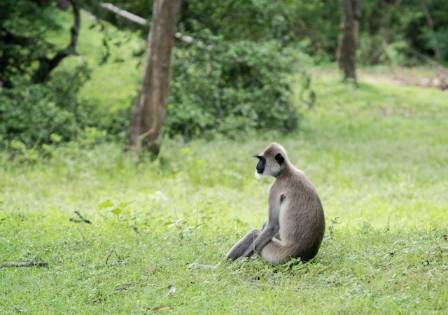
The story of the sacred monkey reaches back more than two thousand years and is closely associated with the ancient Hindu epic centered on Hanuman, the revered monkey deity.
Corwin Hayes
Library note
Reading tip
The full chapter continues below on the soft reading shelf.
Stack
Pocket Library
The story of the sacred monkey reaches back more than two thousand years and is closely associated with the ancient Hindu epic centered on Hanuman, the revered monkey deity.
According to the legend, Hanuman performed extraordinary acts of bravery during a struggle between good and evil. He traveled across the sea from India to the island kingdom of Lanka, present-day Sri Lanka, in an effort to rescue a queen who had been taken captive. In the tale, Hanuman set the enemy city ablaze with his burning tail, creating a diversion that helped the captive queen escape. Hanuman remains an important figure of worship today, while his darkened body and face are often regarded as symbols of courage and power.
Many practicing Hindus believe that the dark appearance of Hanuman langurs reflects their special association with the monkey god. Yet these primates are remarkable for much more than their cultural significance. They also possess impressive survival skills and display highly complex social relationships.
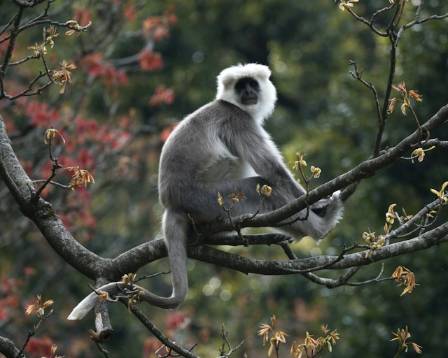
For decades, scientists have examined these monkeys because of their unusual way of life, which can involve both close cooperation and severe competition within groups. The Hanuman langur (Semnopithecus entellus) has successfully adapted to an extraordinary variety of habitats, ranging from the intensely hot deserts of India to the snow-covered mountains of the Himalayas. Among primates, humans are essentially the only other species capable of occupying such a broad range of environments.
Living Alongside Humans
In cities such as Jodhpur, close to the Thar Desert, Hanuman langurs are frequently seen sitting on rooftops and traveling through busy urban areas.
Their success in human settlements is partly connected to their sacred reputation. Because many residents regard them as descendants or representatives of the monkey god, the animals are often tolerated, protected, and deliberately fed. Their food may include vegetables, rice, sweets, drinking water, and leftover human meals.
Researchers observing urban populations have found that local residents generally accept the presence of these monkeys. Although langurs sometimes take food or enter places where supplies are stored, they are usually tolerated by nearby communities. In some cases, they have even been seen grooming stray dogs, despite the fact that certain dogs can potentially hunt monkeys.
A Digestive System Built for Survival
The ability of Hanuman langurs to live across an enormous geographical area, including India, Pakistan, Sri Lanka, Nepal, Bangladesh, and possibly parts of Bhutan and China, is closely related to their specialized digestive system.
Like other colobine monkeys, which are adapted to consuming large quantities of leaves, Hanuman langurs have complicated stomachs divided into multiple chambers. This structure allows them to process tough plant material much more effectively.
Microorganisms living within their digestive systems assist in breaking down cellulose. Because of this adaptation, Hanuman langurs can survive on foods such as mature foliage, unripe fruit, seeds, and tree bark.
Their capacity to process difficult plant foods gives them a major survival advantage. Researchers have even recorded populations living largely on plants that appear toxic and would be harmful to many other animals. On Mount Abu in India, for instance, certain langurs have survived for periods almost exclusively by consuming lantana berries, which are poisonous to numerous other species.
Dietary Flexibility Across Seasons
Scientists estimate that approximately 17 species of langurs exist around the world, with Hanuman langurs being one of several species occurring in India.
Different populations can vary considerably in both body size and coloration, with individuals ranging from gray to dark brown and golden tones. Females generally weigh about 25 pounds, while males average roughly 40 pounds.
Despite differences between populations, Hanuman langurs are remarkably versatile when selecting food.
In the forests around Ramnagar in Nepal, for example, their diet changes according to the season. During the monsoon, they consume substantial quantities of fruit and tender leaves. They may also eat slow-moving caterpillars to obtain additional protein.
When winter arrives, flowers and dried fruits produced by certain climbing plants become important food sources. In spring, the monkeys are able to consume almost any vegetation that is available.
This remarkable dietary flexibility helps them remain successful in places where the amount and type of available food can change considerably throughout the year.
Masters of Extreme Environments
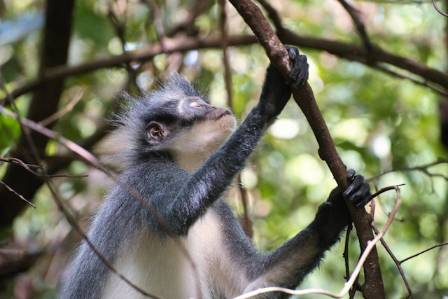
Their ability to adapt to different foods and conditions allows Hanuman langurs to occupy one of the broadest habitat ranges found among primates.
They occur from lowland environments to the high Himalayas, where populations have been recorded at elevations approaching 14,000 feet.
In cold mountainous areas, the monkeys may sit closely together with their dark faces directed toward the sun, using the sunlight to gain warmth. Some travelers have even mistaken their thick gray coats for the legendary Yeti.
Food becomes increasingly limited at extreme elevations. Mountain populations may therefore survive for extended periods by consuming lower-quality resources, including mature leaves and tree bark.
During warmer periods, they may also feed on agricultural crops such as wheat, barley, and potatoes. This behavior can sometimes create conflicts between the monkeys and farmers.
Social Life and Group Structure
Hanuman langurs are strongly social primates and generally live in organized groups known as troops.
A large part of their daily routine revolves around finding food, caring for young, grooming one another, mating, and maintaining relationships within the group.
Although troops are often relatively peaceful, serious conflict can occur when the dominant male changes.
A troop is commonly led by a dominant adult male, but younger males may challenge his position. After gaining control, a new male may kill infants that were fathered by the previous leader. Removing unrelated infants can cause their mothers to become fertile again sooner.
This behavior, called infanticide, is among the most extensively studied forms of reproductive competition in primates.
Predator Defense and Communication
Living in trees gives Hanuman langurs protection from a number of predators, including leopards, hyenas, wild dogs, pythons, and tigers.
When a threat is detected, members of the troop gather together and may produce a distinctive warning vocalization known as a cackle bark.
This loud and harsh call alerts other members of the group and can also assist researchers in locating predators. By following the direction from which the calls originate, scientists can sometimes determine where a leopard or another threat is present.
Social rank also affects where individual monkeys sleep. Dominant males generally choose higher and safer locations in trees, while younger males may be left in lower and more exposed positions.
As they mature, males usually leave their original birth groups. This reduces the possibility of inbreeding and allows them to join another troop or form groups made up primarily of bachelor males.
The Complex Evolution of Infanticide
The discovery that langurs sometimes kill infants forced scientists to reconsider earlier assumptions about animal behavior.
Later research offered an evolutionary explanation for the behavior. When a new male takes control of a troop, killing unrelated infants may give him a greater opportunity to reproduce because females stop nursing and can become fertile again sooner.
Studies have found that males generally avoid killing their own offspring. This pattern supports the idea that infanticide is connected to reproductive competition rather than uncontrolled or random aggression.
Female langurs have also developed possible strategies for protecting their young. Some females mate with several males, which may make paternity less certain. If a male cannot determine whether an infant is his own offspring, he may be less likely to kill it.
Conservation Challenges
Hanuman langurs are not currently considered endangered, but they face many of the same pressures affecting primates around the world.
Habitat destruction, expanding cities, increasing human activity, and conflicts with farmers all pose challenges to their long-term survival.
Their sacred status provides considerable protection for many individuals living around temples, towns, and cities. However, populations living in natural habitats continue to experience growing environmental pressure.
Researchers note that these monkeys may remain capable of surviving around human settlements where people provide food and tolerate their presence. Their future in natural environments, however, remains less certain if habitat loss and other environmental changes continue.
COVER · en

Seals: The Playful Performers of the Sea
Imagine the endless horizon of the ocean, where waves brush softly against the coast and the breeze carries the fresh scent of saltwater.
COVER · en

The Pasta Shapes We Always Come Back To
At Serious Eats, pasta inspires strong feelings. Everyone has favorite noodle shapes, strong dislikes, and very specific reasons behind their choices.
COVER · en

10 Intriguing Insights Into the American Robin
While they are frequently observed in many environments, there is much to discover about this specific thrush species. The American Robin is among the most recognized and widely distributed songbirds in North America. Occupying habitats ranging from dense woodlands and open meadows to suburban gardens and city parks across Canada, the United States, and Mexico, this bird also serves as the state symbol for Wisconsin, Michigan, and Connecticut. While many recognize their cheerful, rhythmic caroling, here are several lesser-known details about this celebrated avian species.
COVER · en
The Stoat – A “Furry Venomous Snake”
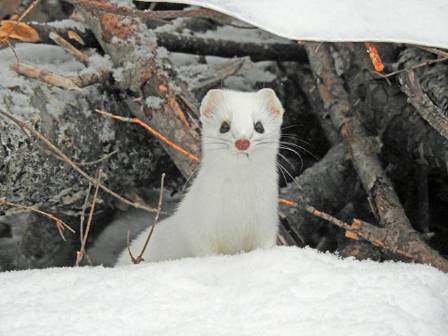
Among the various animal remains preserved in magical object collections, there are several heads and dried bodies of stoats (Mustela erminea, known as “kärppä” in Finnish). While it is easy to understand why large and powerful animals, such as bears, were considered valuable in traditional magic, the reason a small predator like the stoat was viewed as meaningful may seem less obvious.
COVER · en

Bluestone Bridge
As you cross the present-day Blue Stone Bridge and listen to the peaceful flow of Wissahickon Creek beneath you, it is difficult to imagine how lively and heavily traveled this same spot once was.
COVER · en
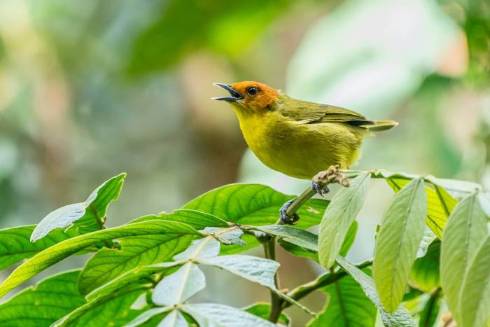
The Enigmatic World of Birdsong: Unraveling the Reasons Behind Their Melodious Chirps
A bird's song is a marvel to the ears of those who pause to listen. It heralds the approach of morning, acting as nature's alarm clock, and graces the peaceful moments of a stroll through the great outdoors. Yet, beyond their melodious notes lies a world of intricate purpose and survival strategy. Let's delve into the harmonious realm of avian serenades to understand why birds sing and the nuanced meanings concealed within their tunes.