
Shelf read
Badminton Made Simple
Badminton is among the world's most widely played sports, enjoyed by millions of people across different countries and cultures. Its fast pace, simple setup, and exciting rallies have helped it gain a large international following.
Sebastian Vale
Library note
Reading tip
The full chapter continues below on the soft reading shelf.
Stack
Pocket Library
Badminton is among the world's most widely played sports, enjoyed by millions of people across different countries and cultures. Its fast pace, simple setup, and exciting rallies have helped it gain a large international following.
The sport is also a major attraction at international events such as the Olympic Games. Badminton became an official Olympic sport at the 1992 Barcelona Olympics, and the mixed doubles event was added four years later at the 1996 Atlanta Olympics. Today, Olympic badminton features five events: men's singles, women's singles, men's doubles, women's doubles, and mixed doubles.
Over the years, China has established itself as one of the most successful badminton nations in Olympic history, while Indonesia has also consistently achieved outstanding results. Although badminton enjoys enormous popularity throughout Asia, European countries such as Denmark regularly produce world-class players who compete for major titles.
If you're interested in learning the sport, here's a beginner-friendly guide covering the rules, scoring system, court dimensions, serving regulations, and equipment used in badminton.
Basic Rules of Badminton
According to regulations established by the Badminton World Federation (BWF), badminton can be played in two formats:
Singles: One player competes against another.
Doubles: Two teams of two players compete against each other.
The objective is simple: hit the shuttlecock over the net and land it within your opponent's court while preventing them from doing the same.
How Scoring Works
Both singles and doubles matches follow a best-of-three-games format.
Each game is played to 21 points.
A point is awarded after every rally.
The side that wins the rally earns the point and serves next.
When the score reaches 20-20, a team must gain a two-point advantage to win the game.
Examples:
22-20 wins the game.
23-21 wins the game.
If the score reaches 29-29, the first side to score 30 points wins the game immediately.
Changing Ends During a Match
Players switch sides of the court under the following circumstances:
After the first game.
After the second game if a deciding third game is required.
During the third game when either side reaches 11 points.
This ensures fairness when environmental factors such as lighting or airflow may affect play.
How to Win a Point
A rally is won when the shuttlecock lands inside the opponent's court, including on the boundary lines.
A player or team loses a point if:
The shuttlecock lands outside the court.
The shuttlecock hits the net and fails to cross.
The shuttlecock passes through or underneath the net.
A player hits the shuttlecock twice consecutively.
A player or racket touches the net during play.
Players must wait until the shuttlecock crosses the net before making contact. While a follow-through may cross over the net after striking the shuttle, direct contact with the net is not allowed.
Serving Rules
A proper serve must follow several important requirements:
The shuttlecock must be struck below the server's waist.
The serve must travel diagonally into the opponent's service court.
Both players must remain stationary until the serve is completed.
Singles Serving Rules
In singles:
Players serve from the right service court when their score is even.
Players serve from the left service court when their score is odd.
The server continues serving as long as they keep winning rallies.
Doubles Serving Rules
In doubles:
The first server begins from the right side.
Teammates alternate service positions after winning points.
If the receiving team wins a rally, they gain the right to serve.
The player who did not initially serve for their team will eventually become the server after their side regains service.
Badminton Court Dimensions
A badminton court has standardized measurements.
Singles Court
Length: 13.41 meters (44 feet)
Width: 5.18 meters (17 feet)
Doubles Court
Length: 13.41 meters (44 feet)
Width: 6.10 meters (20 feet)
Net Height
Height at the posts: 1.55 meters (5 ft 1 in)
Height at the center: 1.52 meters (5 ft)
Service Lines
The short service line is located 1.98 meters (6.5 feet) from the net.
A center line divides the service area into left and right sections.
In doubles, the long service line is positioned 0.76 meters (2.5 feet) inside the back boundary line.
Each service box measures approximately:
3.96 meters (13 feet) long
2.59 meters (8.5 feet) wide
The Shuttlecock (Birdie)
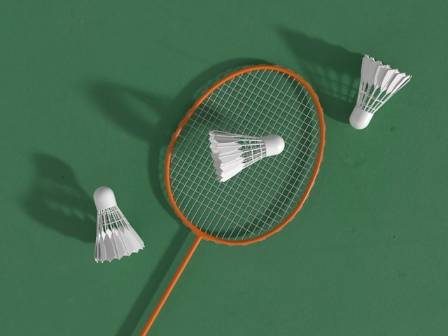
Unlike many sports that use a ball, badminton uses a shuttlecock, commonly called a birdie.
Its distinctive shape allows it to fly with the cork end leading after being struck.
A shuttlecock is made from either:
Natural feathers, or
Synthetic materials
These are attached to a cork or rubber base.
Official Specifications
A regulation shuttlecock typically has:
16 feathers
Length between 62 mm and 70 mm
Weight between 4.74 grams and 5.50 grams
Feather circle diameter of 58 mm to 62 mm
Cork base diameter of 25 mm to 28 mm
The base is rounded, helping maintain stable flight characteristics throughout play.
Final Thoughts
Badminton combines speed, skill, strategy, and athleticism, making it one of the most exciting racket sports in the world. Whether you're playing singles or doubles, understanding the scoring system, serving rules, court markings, and equipment specifications will help you enjoy the game and improve your performance. With simple equipment requirements and easy-to-learn fundamentals, badminton is a sport that players of all ages can enjoy.

COVER · en
Perfect Sushi Rice Recipe
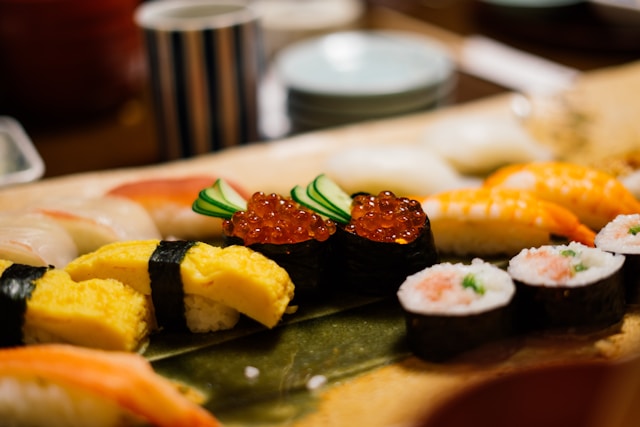
We love sushi, and sometimes we make various types at home, such as maki rolls, chirashi, hand rolls, nigiri, and other sushi styles. To make great sushi at home, the key is perfect sushi rice, also called sushimeshi or vinegared rice.
COVER · en

The Most Unique Lighthouses in the World
Lighthouses once played a vital role in coastal navigation. Far from mere decorative structures, they acted as beacons, guiding ships safely through darkness and storms while marking hazardous rocks, reefs, and shorelines. Lighthouse keepers were the maritime equivalent of air traffic controllers, ensuring vessels reached their destinations safely. Today, electronic navigation systems have largely replaced them, yet lighthouses remain as historic, picturesque landmarks—symbols of maritime heritage and captivating coastal scenery.
COVER · en

A New Perspective on Landscape Art: 10 Landmark Paintings
For centuries, scenes of nature struggled to earn their place among established artistic themes. It wasn't until the 1600s that depictions of the natural world gained equal footing with historical narratives, portraiture, and still lifes. The 1800s marked a pivotal era, especially with the emergence of the Barbizon painters around 1830, who embraced the outdoors as their open studio. Landscapes transformed from mere backdrops to central subjects, celebrated for their raw beauty and evocative power. From woodland groves to coastal cliffs and cultivated plains, artists used these environments to convey emotion, philosophy, and prophecy. Below are ten essential works that showcase the evolution of landscape painting—each offering its own window into a different world.
COVER · en

The Japanese Sika Deer: Ecology, Culture, and Conservation
The Japanese sika deer (Cervus nippon nippon) stands as one of the most adaptable and biologically significant subspecies of sika deer, native to the forested landscapes of Japan. Renowned for its striking appearance and complex behavioral patterns, this small deer has not only shaped the ecosystems of its native habitat but also left a lasting mark on human culture and global conservation efforts. While its population thrives in Japan, its introduction to other continents has sparked both ecological challenges and innovative conservation solutions, making it a species of great interest to biologists, ecologists, and cultural historians alike.
COVER · en

Key Considerations for Selecting a Family-Oriented SUV
Expanding your family naturally shifts your priorities when it comes to vehicle shopping. Details that seemed trivial in the past suddenly become essential once children are part of the daily commute. Drawing from extensive automotive testing and parenting experience, we have identified the most critical elements to look for in a family-friendly SUV to ensure safety, convenience, and comfort.
COVER · en

4 Cutest Bunny Breeds That Make Adorable Companions
If you're searching for a delightful pet that’s a bit different from the usual dogs and cats, you might want to consider adding a bunny to your family. Rabbits are charming, affectionate, and often easier to care for than you might think. With many breeds to choose from, including some that are quite rare, we’ve compiled a list of four of the cutest bunny breeds that could be the perfect fit for your home.