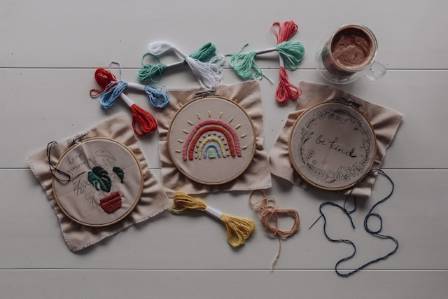
Embroidery is more than just crafting intricate patterns and attractive designs. It’s an art form that conveys history and culture simply through its appearance.
The realm of needlework is captivating, and showcasing renowned embroidery styles from across the world is an excellent way to delve into it.
Once you explore our list of famous embroidery, you’ll likely find yourself eager to learn even more about cultural embroidery from additional regions.
1. Chikankari
Chikankari is a both delicate and complex embroidery style hailing from Lucknow, the land of refinement and elegance. It’s said to have been introduced by Nur Jehan, the wife of Mughal emperor Jahangir.
While Chikankari flourished during Mughal rule, references to the art date back as early as the 3rd century BC, when Megasthenes wrote about Indians using flowered muslins.
To create a Chikankari piece, patterns are first block printed onto the fabric. Craftsmen then embroider stitches following the printed design. After embroidery is complete, the finished piece is washed to remove any traces of the prints.
Chikankari began as a type of white-on-white embroidery but now uses a wide variety of fabrics and colors. From white thread stitched on refreshing pastels to bright silk threads, Chikankari has evolved into an art form beloved by embroidery enthusiasts with a taste for finer styles.
2. Brazilian Dimensional Embroidery
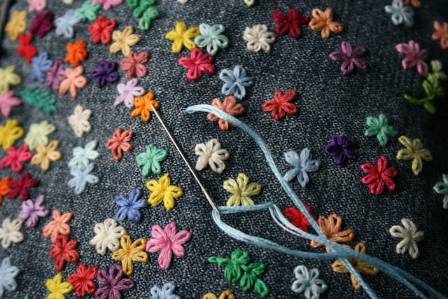
Brazilian embroidery is a form of surface embroidery that uses rayon instead of cotton or wool. It’s called “Brazilian” because the use of high-sheen rayon thread in embroidery first gained popularity in Brazil, where rayon was widely produced.
Brazilian embroidery patterns typically feature flowers created using both knotted and cast-on stitches. Thanks to its smoothness, rayon thread makes it easier for craftsmen to pull the needle through wrapped stitches like bullion stitches.
Milliners needles—with a straight shaft and an eye no wider than the shaft—are mainly used for the wrapped stitches that are a hallmark of Brazilian embroidery.
While many of these stitches are common in other embroidery forms, the technique used to create them makes Brazilian embroidery unique. The difference lies in how rayon thread is manufactured.
For example, cotton thread uses an S twist when fiber plies are twisted into a strand. Rayon thread, however, uses a Z twist, where one variation twists the fiber plies clockwise and the other counterclockwise.
When creating knots in Brazilian embroidery, the embroiderer must wrap the thread around the needle in the opposite direction of other embroidery styles. Otherwise, the thread fibers will unwind, resulting in unattractive final stitches and knots.
3. Kantha
The charm of Kantha embroidery lies in its simplicity. This embroidery style is traditionally practiced in Bengal and Odisha, particularly by rural women.
In the past, Kantha was done on soft dhotis and sarees, using a simple stitch along the edges. Interestingly, the thread for this stitch was taken from the border threads of the same cloth.
Kantha embroidery is characterized by themes of birds, animals, flowers, and daily activities, depicted using a running stitch with short gaps. Today, Kantha adorns sarees, dresses, bedspreads, upholstery, wall hangings, and more.
4. Sashiko
A form of Japanese folk embroidery, Sashiko uses basic running stitches to create a patterned background. The Japanese word “Sashiko” translates to “little stabs,” referring to the small stitches used in this needlework.
Originally, Sashiko served as a form of darning to repair or reinforce torn or worn parts of clothing, or to make insulated double-layer coats. However, its combination of beauty and durability turned it into an art form rather than just a functional stitch.
Highly popular among quilters, traditional Sashiko designs draw inspiration mainly from nature—such as cloud shapes, rippling water or waves, flowers, and leaves. Designs can also be geometric, featuring interlocking lines (straight or curved), stars, squares, triangles, and circles arranged in a repeating pattern.
Tessellating designs, where repeating shapes interlock, are common themes in Sashiko embroidery. Traditionally, Sashiko uses indigo-dyed fabric and white Sashiko thread.
5. Phulkari
Punjab is famous not only for delicious Sarson da saag and Makki di roti but also for Phulkari embroidery, which comes to mind first when thinking about the state in the embroidery world. “Phulkari” means “floral work,” so this needlework involves embroidering flower motifs on fabrics. Though unique, this embroidery style was traditionally practiced by women in the home to pass the time.
Phulkari stitches are embroidered on the reverse side of the cloth, allowing the design to take shape on the front. The fabric of choice is usually hand-spun or naturally dyed khadi cloth.
What makes Phulkari most distinctive is the contrast of bright colors against lighter-colored fabric.
6. Zardozi
Originating from Persia, Zardozi is an ancient art of embroidering gold and silver threads onto fabric. This needlework was once exclusive to embellishing royal garments and gained prominence in the 17th century during the rule of Mughal emperor Akbar.
Traditional Zardozi uses gold and silver threads, as well as pearls and precious stones. The fabrics chosen were also royal, with plush velvets and rich silks complementing this luxurious embroidery.
Today’s Zardozi, however, uses a combination of copper wire with silver or gold polish and silk threads. This hasn’t diminished the style’s extravagant feel but has made it more accessible.