Shelf read
Sting Rays at California State Beaches
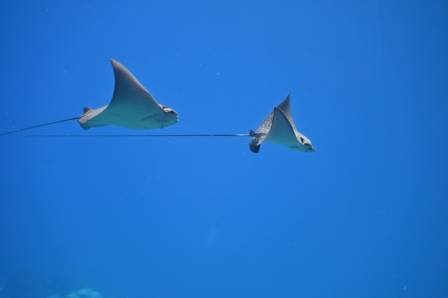
Stingrays are bottom-dwelling fish that are often found partially hidden beneath the sand in shallow coastal waters. Their bodies are broad and flattened, with their eyes and nostrils positioned on the upper surface, while their mouths and gill openings are located underneath.
Selena Ward
Library note
Reading tip
The full chapter continues below on the soft reading shelf.
Stack
Pocket Library
Stingrays are bottom-dwelling fish that are often found partially hidden beneath the sand in shallow coastal waters. Their bodies are broad and flattened, with their eyes and nostrils positioned on the upper surface, while their mouths and gill openings are located underneath.
Their primary means of protection is camouflage. They generally rely on blending into the sandy seafloor rather than actively attacking potential threats. However, if a person accidentally steps on a stingray, the animal may respond defensively by striking with its tail.
The stingray's defensive apparatus consists of its tail, one or more sharp barbed spines attached to the tail, and venom associated with those spines. The spine is generally around 1 to 1.5 inches long and is made from a hard, tooth-like substance. Along its surface are numerous tiny barbs or serrations that resemble small fishhooks and point in the direction opposite the tip.
The spine is enclosed within a thin covering that contains a combination of venom and mucus. When the spine penetrates the skin, this material can enter the wound and cause significant pain and tissue injury.
Treating Stingray Injuries with Hot Water
Although stingray encounters are not particularly common, understanding how to respond to a sting can be extremely useful. Prompt treatment can help control the intense pain and support proper recovery.
One of the primary treatments recommended for a stingray injury is immersion of the affected body part in hot, fresh water. The following information explains why this approach is used, how it may help, and how to apply it safely.
Understanding Stingray Stings
Stingrays have sharp, serrated spines on their tails that serve as defensive weapons. They may use these spines when they feel threatened or when someone accidentally steps on them.
A stingray spine can puncture the skin, introduce venom, and damage underlying tissue. The resulting injury may produce severe pain and swelling, and in some cases the wound can later develop a secondary bacterial infection.

Why Hot Water Can Help
Heat Can Reduce the Activity of the Venom
The venom delivered by a stingray is heat-sensitive. Exposing the injured area to sufficiently hot water can help reduce the biological activity of the venom. Lowering its potency may decrease pain and potentially limit the effects of the venom within the affected tissues.
Hot Water Can Relieve Pain
Warm or hot water can also have a pain-relieving effect. The heat may relax muscles, soothe irritated nerve endings, and increase circulation around the injured area. These effects can make the intense discomfort of a sting more manageable and may support the healing process.
It May Help Reduce the Risk of Infection
Because a stingray puncture can introduce bacteria and other microorganisms into the body, infection is a possible complication. Hot-water immersion can assist with cleansing the injured area while increased blood flow may support the body's natural response to contamination.
How to Use Hot Water Treatment
Water Temperature
The water should be hot enough to be effective but never so hot that it causes a burn. A temperature of approximately 104°F to 113°F is generally recommended.
Treatment Time
Keep the injured area immersed in hot water for approximately 30 to 90 minutes, or until the pain has noticeably decreased. The temperature should be checked regularly during treatment, and additional hot water can be added if necessary to maintain the appropriate warmth.
Safety Precautions
Do not use dangerously hot water. Excessive heat can burn the skin and make existing tissue damage worse.
People who have reduced sensation, including those with neuropathy, diabetes, or paralysis, need to be particularly careful because they may not recognize that the water is hot enough to cause a burn.
When to Seek Medical Care
Hot-water immersion can provide substantial temporary pain relief, but medical evaluation is still important after a stingray injury. Professional medical attention is particularly necessary when the wound is deep or extensive, or when bleeding is severe and does not stop on its own.
Medical care should also be sought if symptoms suggest an infection, including worsening pain, increasing redness or swelling, or discharge from the wound.
An allergic reaction is another reason to obtain immediate medical assistance. Concerning symptoms can include difficulty breathing, wheezing, an itchy rash, nausea, or vomiting.
Important Safety Information
Alcohol, urine, and ammonia-based solutions should not be applied to wounds caused by marine animal stings or bites. These substances can potentially cause additional venom release or otherwise aggravate the injury.
If a spine or stinger remains in the wound, it should be removed carefully and with suitable protective equipment to avoid causing another injury. Because marine animal injuries can lead to complications, appropriate medical advice should always be obtained when necessary to ensure proper treatment and reduce the risk of further problems.
COVER · en

The Honeyeater: Australia's Nectar-Loving Aviators
Australia's rich birdlife includes one of the continent's most widespread and successful families: the honeyeaters. These fascinating birds have diversified into an impressive range of species, each adapted to take advantage of the abundant nectar produced by Australia's distinctive native plants. From tiny species to large wattlebirds, honeyeaters are an outstanding example of evolutionary adaptation within Australian wildlife.
COVER · en

The Ultimate Cosmic Trap
For over a century, black holes have fascinated both scientists and dreamers. These mysterious cosmic objects trap everything that comes too close, even light itself. But some physicists wonder if black holes might be more than just points of no return. Could they actually be gateways to other dimensions or even new universes? The idea may sound like science fiction, but it is based on real scientific theories that researchers are still exploring today.
COVER · en

5 Positive Impacts of Companion Animals on Human Health
Interacting with companion animals, spanning various species such as dogs, cats, rabbits, rodents, horses, fish, birds, reptiles, and amphibians, offers a multitude of physical and mental health benefits for individuals. The close interconnection between animal and human health is encapsulated in the concepts of 'One Health' and 'One Welfare,' where animals are recognized as promoters and forecasters of human well-being.
COVER · en

Hanuman Langurs: The Sacred Monkeys of India
The story of the sacred monkey reaches back more than two thousand years and is closely associated with the ancient Hindu epic centered on Hanuman, the revered monkey deity.
COVER · en

Choosing The Right Wall Clock For Your Home
Wall clocks are more than just timekeeping devices—they play a significant role in home décor, blending function with style. A thoughtfully selected wall clock can become a standout element in any room, capturing attention while reflecting your personal taste. Beyond helping you track time, the right clock can uplift the overall atmosphere of your living space.
COVER · en

From Traditional Chinese Attire to Modern Elegance
The cheongsam, or qipao as it was originally known, is a timeless traditional Chinese dress with a rich history dating back to the seventeenth century. The term "cheongsam" itself means 'long dress' in contemporary usage, but its origins can be traced to the Qing Dynasty in its primitive form. Initially, it was a one-piece, wide-sleeved dress that enveloped the wearer from neck to foot, exemplifying modesty. Variations also existed, such as a two-piece ensemble with long trousers complemented by a flowing overdress.