Shelf read
Understanding Star Trails and How to Capture Their Motion
Star trails are a captivating form of long-exposure photography that reveals the movement of stars across the sky over several minutes or hours. While we cannot feel the Earth’s rotation in our daily lives, these images provide a vivid, silent testament to the fact that everything in our universe is in constant motion. By using a steady mount and extended shutter speeds, any photographer can record these mesmerizing circular patterns.
Lydia Florence Radcliffe
Library note
Reading tip
The full chapter continues below on the soft reading shelf.
Stack
Pocket Library
Star trails are a captivating form of long-exposure photography that reveals the movement of stars across the sky over several minutes or hours. While we cannot feel the Earth’s rotation in our daily lives, these images provide a vivid, silent testament to the fact that everything in our universe is in constant motion. By using a steady mount and extended shutter speeds, any photographer can record these mesmerizing circular patterns.
The Science Behind the Streaks
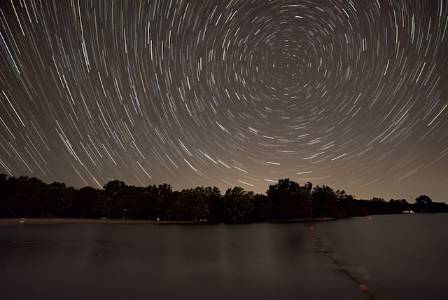
Star trails are a direct reflection of Earth’s rotation around its axis. Our planet completes a full turn relative to the stars in approximately 23 hours and 56 minutes—a period astronomers refer to as a sidereal day. Because we are standing on a spinning globe, the stars appear to move across the sky from east to west, much like the sun does during the day.
The appearance of these trails depends on where the camera is pointed. Stars located near the celestial poles—such as Polaris in the Northern Hemisphere—create the smallest, tightest circles. Stars near the celestial equator produce the widest arcs. Mathematically, every star moves westward at a rate of 15 degrees per hour. Therefore, star trails are essentially partial circles that visually tabulate the steady passage of time.
Essential Equipment for Trail Photography
Capturing the dance of the stars requires a few basic tools. First, you need a camera with manual settings that allows you to control the aperture (f/stop), shutter speed, and ISO. A wide-angle lens is highly recommended; the wider the field of view, the more expansive the star trails will appear.
A sturdy tripod is perhaps the most critical piece of gear, as even the slightest vibration during a long exposure can ruin the sharpness of the image. Additionally, an intervalometer is used to shoot a succession of frames automatically. While some cameras have this built-in, many photographers prefer an external remote to hold the shutter down in continuous shooting mode, ensuring there are no gaps between the 30-second exposures.
Techniques for Successful Captures
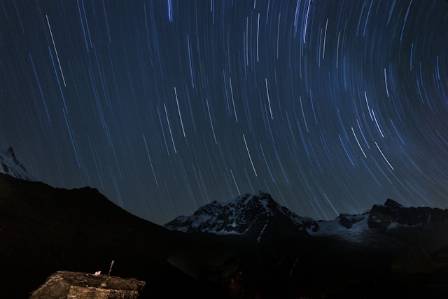
To begin, ensure your camera is perfectly level. Focus on a bright star and then switch to manual focus to lock it in place. Common settings include a 30-second shutter speed, an ISO between 400 and 800, and an aperture opened as wide as possible (such as f/2.8).
Modern star trail photography often involves taking many short exposures rather than one single, hours-long shot. This method prevents the sensor from overheating and reduces digital noise. By merging a hundred or more 30-second frames in post-processing, you create a composite image where the stars form continuous, luminous arcs. Polaris, the North Star, will appear as a tiny arc at the center of these concentric circles, while constellations like Cassiopeia or Perseus will create brighter, larger streaks around it.
Post-Processing and Final Touches
The final step in creating a masterpiece is stacking the images. Specialized software, such as Startrails or StarStaX, is often used to merge the individual frames into a single composite. These programs are designed to identify the brightest pixels in each photo and layer them, effectively "connecting the dots" to form smooth lines.
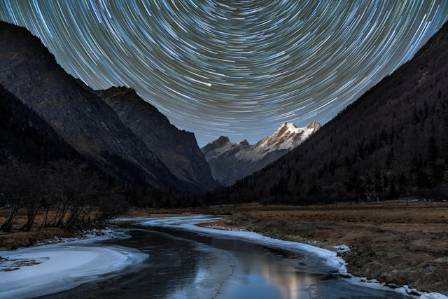
Through this process, you may even notice color variations that aren't visible to the naked eye; stars are not all white, and your camera will pick up subtle yellows, blues, and pinks. Whether you are capturing the stars over a mountain range, a calm lake, or even alongside the aurora borealis, the result is a profound reminder of our place within a moving cosmos.
COVER · en

The Tale of the Snake Plant
The Snake Plant, scientifically called Dracaena trifasciata and previously classified as Sansevieria trifasciata, is one of the most recognizable indoor plants around the world. It is loved for its durability, striking upright leaves, and simple care requirements. It is also commonly known as Mother-in-Law’s Tongue or Saint George’s Sword. Beyond its popularity as a decorative houseplant, the Snake Plant has a long and interesting story that connects its native environment with its role in modern gardening.
COVER · en

Hegra: The Ancient City in Saudi Arabia
Situated in Al Ula, Hegra is among the lesser-visited destinations in Saudi Arabia, a country that has only recently begun welcoming international tourists. Unlike many established attractions, Hegra is not filled with large crowds or guides competing for visitors’ attention. Instead, its greatest appeal comes from its peaceful and secluded atmosphere.
COVER · en
The Speed Demons of the Animal Kingdom: Top 10 Swiftest Creatures on Earth
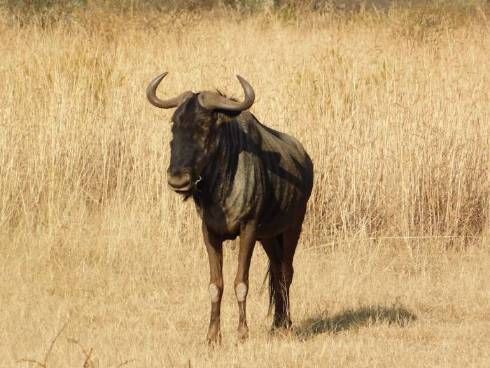
Human beings, despite their considerable intelligence and evolving technological prowess, remain considerably slower than many of their animal counterparts. The world is home to thousands of species that can outpace even the fastest human. While the maximum running speed of a human caps at approximately 27.5 miles per hour, several animals can effortlessly double that pace.
COVER · en

The Comprehensive Guide to SUVs
Sport-utility vehicles (SUVs) dominate the U.S. automotive market. Buyers are attracted to SUVs for their higher driving position, all-wheel or four-wheel drive capabilities, off-road potential, flexible interiors, and the prestige associated with their size compared to conventional cars.
COVER · en

32 Creative Flower Bed Ideas to Brighten Your Garden
If you're looking to infuse some color into your front yard or craft a serene sanctuary in your backyard, these 32 flower bed ideas will inspire you.
COVER · en

What Is Ice Cream?
How Ice Cream is Made and How to Store It