PL
pipilandbook.com
5 Fascinating Facts About the Ostrich: The World’s Largest Flightless Bird

Shelf read

5 Fascinating Facts About the Ostrich: The World’s Largest Flightless Bird

The ostrich (Struthio camelus) stands unrivaled as the largest and heaviest living bird on Earth, a towering icon of Africa’s savannas and arid landscapes. Belonging to the ratite family—a group of flightless birds characterized by flat breastbones—ostriches share their lineage with equally unique relatives like emus, cassowaries, rheas, and kiwis, each adapted to thrive in distinct corners of the globe. In recent decades, taxonomic research has led authorities to classify the Somali ostrich (Struthio molybdophanes), native to the dry regions of East Africa, as a separate species from the common ostrich found across sub-Saharan Africa. Beyond their imposing size, ostriches hold a host of remarkable records and evolutionary quirks that set them apart from all other avian species. Below are five captivating facts that shed light on these extraordinary birds.

N

Nora

Library note

Reading tip

The full chapter continues below on the soft reading shelf.

Stack

Pocket Library


The ostrich (Struthio camelus) stands unrivaled as the largest and heaviest living bird on Earth, a towering icon of Africa’s savannas and arid landscapes. Belonging to the ratite family—a group of flightless birds characterized by flat breastbones—ostriches share their lineage with equally unique relatives like emus, cassowaries, rheas, and kiwis, each adapted to thrive in distinct corners of the globe. In recent decades, taxonomic research has led authorities to classify the Somali ostrich (Struthio molybdophanes), native to the dry regions of East Africa, as a separate species from the common ostrich found across sub-Saharan Africa. Beyond their imposing size, ostriches hold a host of remarkable records and evolutionary quirks that set them apart from all other avian species. Below are five captivating facts that shed light on these extraordinary birds.

Ostriches Are the Fastest Two-Legged Land Creatures on Earth

Ostriches are built for speed, with long, muscular legs and a streamlined body that lets them reach a top running speed of 70 kilometers per hour (43.5 miles per hour)—a feat that makes them not only the fastest land bird but also the swiftest two-legged creature on the planet, outpacing most flying birds in horizontal speed. When sprinting at full tilt, an ostrich covers an astonishing 5 meters (16.4 feet) with each stride, propelled by powerful thigh muscles that allow it to accelerate rapidly and maintain high speeds for short bursts. This incredible speed is a critical survival adaptation, enabling ostriches to outrun predators like lions, leopards, and hyenas in the open savanna, where their lack of flight leaves them with few other escape options. Even young ostriches can run at speeds of 50 km/h within months of hatching, a testament to the species’ innate athleticism.

Ostrich Eggs Are the Largest of Any Bird—Yet the Smallest Relative to Body Size
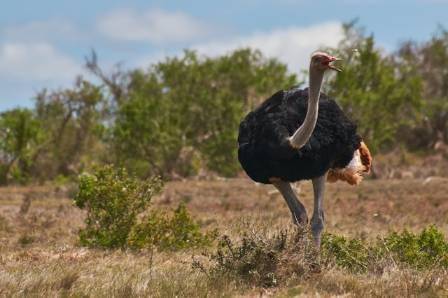
Ostriches lay the largest eggs of any living bird, with a single egg measuring up to 15 centimeters (6 inches) in length and weighing as much as 1.4 kilograms (3 pounds)—roughly 20 times the size of a domestic chicken’s egg. These eggs are encased in a thick, hard shell that can support the weight of an adult human, protecting the developing embryo from predators and environmental damage. What makes ostrich eggs even more fascinating, however, is that they are the smallest eggs relative to the mother’s body size of any bird species. An adult female ostrich can weigh over 120 kilograms (265 pounds), meaning her egg accounts for just 1.1% of her body weight—a stark contrast to a chicken egg, which makes up about 3% of a hen’s body weight. This proportional difference is an evolutionary advantage, allowing female ostriches to lay multiple eggs (up to 15 per clutch) without expending excessive energy or hindering their mobility.

Ostriches Have the Largest Eyes of Any Land Animal

Despite their massive size, ostriches have relatively small brains—but their eyes are the largest of any land animal, measuring a whopping 5 centimeters (2 inches) in diameter, about the size of a tennis ball. These enormous eyes are equipped with long, thick eyelashes that shield them from the harsh African sun, dust storms, and flying debris, while their keen eyesight allows them to spot predators from a distance of up to 3 kilometers (1.9 miles). This exceptional visual acuity is vital for survival in the open savanna, where early detection of danger can mean the difference between life and death. The eyes are positioned on the sides of the ostrich’s head, providing a wide field of vision that lets them monitor their surroundings for threats even while feeding on plants and seeds.

Ostriches Don’t Bury Their Heads in Sand—But They Do Eat Stones to Digest Food

One of the most persistent myths about ostriches is that they bury their heads in the sand when frightened, a tale likely popularized by the Roman historian Pliny the Elder in the first century AD. In reality, ostriches never engage in this behavior; when threatened, they either run away at top speed or drop to the ground and lie flat, using their spotted plumage to blend into the savanna vegetation. A far more intriguing truth about ostriches is their habit of ingesting small stones, pebbles, and gravel—known as gastroliths—to aid digestion. Since ostriches lack teeth to chew their food, these hard particles accumulate in their gizzard, a muscular organ that grinds down tough plant matter, seeds, insects, and even small vertebrates. The gastroliths act as a natural “grinding mill,” breaking down food into smaller, more digestible pieces that can be absorbed by the intestines. Over time, the stones wear down and are replaced with new ones, a process that is essential for the ostrich’s survival on its varied diet.

Ostriches Are Flightless Because of Their Flat Sternum (No Keel for Wing Muscles)
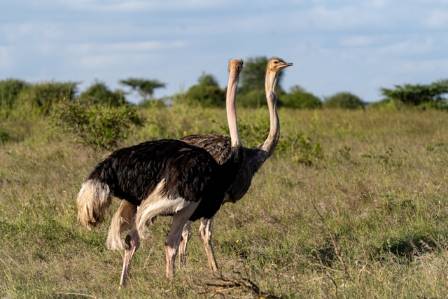
The ostrich’s inability to fly stems from a key anatomical feature tied to its membership in the ratite family. The word “ratite” comes from the Latin ratis, meaning “raft,” a reference to the group’s flat, raft-like sternum (breastbone). Unlike flying birds, which have a prominent, ridge-like keel on their sternum to anchor the powerful flight muscles needed to flap their wings, ratites have a smooth sternum with no keel. This means that even if ostriches had wings large enough to generate lift, they would lack the muscle mass required to power flight. Ostriches’ wings are not useless, however—they serve as balance aids when running at high speeds, help regulate body temperature by shading the bird from the sun, and are used in courtship displays, where males spread their wings to show off their striking black-and-white plumage to attract females. This evolutionary trade-off—sacrificing flight for speed and size—has allowed ostriches to become one of the most successful and iconic species in the African ecosystem.

More on this shelf

CV

COVER · en

Effective Indoor Attire for Maintaining Body Heat

Effective Indoor Attire for Maintaining Body Heat

High energy costs often make heating an entire residence impractical. A more cost-effective strategy involves maintaining personal warmth while moving through cooler areas of the home. By focusing on personal insulation, you can remain comfortable without relying on expensive central heating.

CV

COVER · en

8 Enchanting Snow Towns

8 Enchanting Snow Towns

Embrace the winter wonderland within the U.S., where snowy landscapes transform towns into magical cold-weather escapes. From Alaska to Vermont, these picturesque communities offer cozy inns, fireside cocoa, ice skating, and a dusting of fresh flakes. Let's explore the allure of these 8 beautiful winter towns:

CV

COVER · en

3 ways make Birthday a Shared Experience

3 ways make Birthday a Shared Experience

Early childhood and adolescent birthdays often center around specific legal and societal milestones, such as enjoying a first slice of cake, entering the teenage years, gaining driving privileges at sixteen, or reaching legal adulthood. Eventually, the focus shifts away from numerical age toward the accumulation of meaningful life chapters. Annual markers transform into a collective memory of adventures, challenges, and shared laughter. These celebrations provide an annual opportunity to honor an individual's distinct identity and appreciate the journey of life itself, rather than simply counting the passage of time.

CV

COVER · en

The Coolest Retro New Cars You Can Buy Right Now

The Coolest Retro New Cars You Can Buy Right Now

If you want a modern vehicle that still carries a vintage feel, there are several retro-inspired models available among today’s new cars. Many automakers regularly draw on their history for design inspiration, especially when working with legendary nameplates that have existed for decades. Whether you prefer nostalgic styling, playful character, or distinctive color themes, this list highlights retro-styled SUVs, coupes, convertibles, vans, and hatchbacks you can buy in 2026.

CV

COVER · en

Top 10 New Convertibles

Top 10 New Convertibles

In an age dominated by SUVs, electric performance cars, and practical crossovers, the appeal of a convertible remains uniquely emotional. These are not vehicles chosen purely for logic or efficiency—they exist for experience.

CV

COVER · en

How to Create Needle-Felted Animals: A Basic Guide

How to Create Needle-Felted Animals: A Basic Guide

If you’ve ever wondered what needle-felted animals have in common with dollhouses and miniatures, the answer is a lot! Tiny needle-felted creatures are an essential part of the miniature world and are absolutely captivating to see.