Shelf read
Fascinating Facts About the World of Crabs
With thousands of identified species spanning the globe, crabs are among the most successful and intriguing crustaceans in our oceans. These animals are more than just coastal inhabitants; they are vital engineers of marine ecosystems, helping to sustain coral reefs and seafloor health. Despite their importance, they face increasing pressure from environmental changes, pollution, and habitat disruption.
Frederick Louis Kingsley
Library note
Reading tip
The full chapter continues below on the soft reading shelf.
Stack
Pocket Library
With thousands of identified species spanning the globe, crabs are among the most successful and intriguing crustaceans in our oceans. These animals are more than just coastal inhabitants; they are vital engineers of marine ecosystems, helping to sustain coral reefs and seafloor health. Despite their importance, they face increasing pressure from environmental changes, pollution, and habitat disruption.
Locomotion and Surprising Speed
While the common perception is that crabs only move sideways, this is not strictly true. Most species possess leg hinges that make lateral movement more efficient and faster, but they are physically capable of walking forward when necessary. The Japanese spider crab—the largest of all living crab species—frequently walks forward, aided by its exceptionally long, spindly limbs.
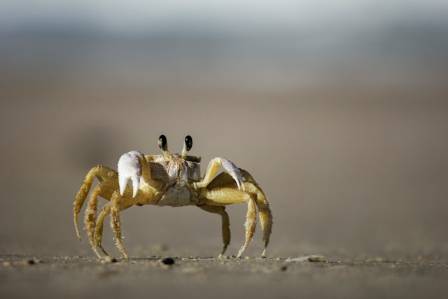
On land, the ghost crab stands out as a true athlete. These tropical beach dwellers can reach sprinting speeds of up to 10 miles per hour, which is roughly equivalent to a human child's running pace. This rapid movement is a defensive adaptation used to flee from predatory birds rather than for hunting, as ghost crabs primarily feed on stationary or slow-moving prey like mollusks and turtle eggs.
Distinguishing True Crabs from "False" Crabs
Not every animal with "crab" in its name belongs to the same biological group. Scientists divide these crustaceans into "True Crabs" (Brachyura) and "False Crabs" (Anomura). Hermit crabs, for instance, are actually closer relatives of lobsters than they are to true crabs.
One simple way to tell them apart is by counting their legs. True crabs typically have four visible pairs of walking legs, while false crabs appear to have only three. In false crabs, the fourth pair is stunted and tucked away. Furthermore, true crabs fold their tails out of sight beneath their shells, whereas false crabs often have visible, fanned tails. Hermit crabs specifically use their long, spiraled tails to anchor themselves securely inside scavenged snail shells.
Evolution and Unique Navigational Skills
Crabs are ancient survivors, having evolved approximately 150 million years ago during the Jurassic period. This means their ancestors inhabited the earth long before the Tyrannosaurus rex or Triceratops. While they likely avoided the notice of giant dinosaurs, prehistoric crabs had to contend with fearsome marine reptiles like plesiosaurs and flying pterosaurs.
To navigate the vast oceans, some species have developed a "sixth sense" for magnetic fields. Using either internal magnetite particles or specialized proteins in their eyes, they can perceive the Earth's magnetic orientation. This biological compass is essential for species like the Christmas Island red crabs, guiding them through their massive annual migrations to the coastline.
Adaptability and Biological Regeneration
Crabs have conquered nearly every watery environment on Earth. While many stay near the shore, the purple land crab of the Caribbean lives almost entirely on land, and the Chinese mitten crab thrives in freshwater rivers. In the extreme depths of the ocean, the Yeti crab survives near scorching hydrothermal vents, sporting hair-like structures on its claws that host specialized bacteria.
One of their most remarkable biological feats is the ability to regenerate lost limbs. If a crab loses a claw or leg, it can eventually regrow it through a series of molting cycles. While the new limb may not be as strong as the original, this regenerative ability is a subject of great interest in medical research, as it may hold clues for improving human wound healing and tissue repair.
Ecological Importance and Smallest Species
The diversity of the crab family is reflected in their size. The pea crab, for example, is the smallest known species, measuring a mere 5 mm. These tiny crustaceans live inside the shells of oysters and clams, acting as parasites that share the food filtered by their hosts.
On a larger scale, crabs play a fundamental role in the marine food web. As omnivorous scavengers, they clean the environment by consuming algae, plankton, and decaying organic matter. They also serve as a primary food source for rays, birds, and octopuses. Because they are so central to the health of the sea, the presence of thriving crab populations is often used as a key indicator of a balanced and healthy ecosystem.
COVER · en

Guide to Rockets
How do rockets work, and what does it take to build one? A beginner-friendly introduction to rocketry can help you understand the fundamental science behind these fascinating machines. From basic concepts to the physics of flight, learning about rockets provides an accessible way to explore the principles that make space travel possible.
COVER · en

Canton Tower: The highest tower in China
Canton Tower, also known as the Guangzhou New TV Tower and affectionately nicknamed the “Slim Lady,” is one of Guangzhou’s most recognizable landmarks. It stands near Chigang Tower in Haizhu District on Yizhou Island, about 125 meters from the southern bank of the Pearl River and the Pearl River New Town. Across the river are Huacheng Square and Haixinsha Island.
COVER · en

Iced Coffee in Minutes
As a devoted coffee enthusiast, I’ve spent years refining my iced coffee formula to make the ultimate summer pick-me-up. Few things are as satisfying as a chilled cup of coffee on a sweltering day—energizing, mood-lifting, and endlessly refreshing.
COVER · en

Handcrafted Holiday Decor: Creative DIY Christmas Tree Ornaments
Transforming your home for the festive season doesn't have to break the bank. After noticing how expensive store-bought decorations have become, the challenge of creating a fully handmade Christmas tree is both rewarding and environmentally friendly. By repurposing common household items, thrifting, and recycling materials like paper, cardboard, and raffia, you can produce a stunning array of unique ornaments. There is a special kind of pride that comes from stepping back to admire a beautifully decorated tree and knowing you crafted every single piece yourself.
COVER · en

Expert Strategies for Capturing the Urban Landscape
Navigating a complex cityscape on canvas requires a strategic approach similar to exploring an unfamiliar metropolis with a map. Without a clear objective and a defined path, an artist can easily become overwhelmed by the intricate details of a bustling urban environment.
COVER · en

Oriental Pearl Tower
Standing at 468 meters tall, the Shanghai Oriental Pearl TV Tower is one of the most famous landmarks in Shanghai. It ranks as the fourth tallest tower in Asia and the sixth tallest tower of its kind in the world. Construction began on July 30, 1991, and the tower was officially completed on October 1, 1994.