Shelf read
Taichung Park and the Historic Mid-Lake Pavilion
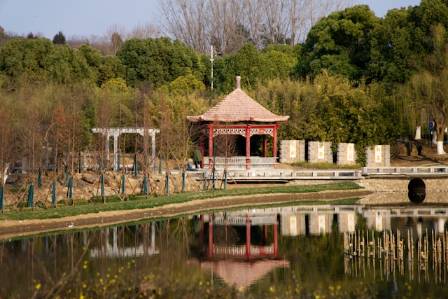
Taichung Park is a 10-acre green space located in the heart of downtown Taichung, central Taiwan. As the city's oldest park, it has a history stretching back more than a century to the period of Japanese colonial rule.
Cora Bellamy
Library note
Reading tip
The full chapter continues below on the soft reading shelf.
Stack
Pocket Library
Taichung Park is a 10-acre green space located in the heart of downtown Taichung, central Taiwan. As the city's oldest park, it has a history stretching back more than a century to the period of Japanese colonial rule.
The large urban park serves as an important recreational space for Taichung residents. Along with the usual facilities found in Taiwanese parks, including playground equipment and basketball courts, it also preserves several historically significant sites. A large lake at the center of the park provides opportunities for kayaking and canoeing, creating an unusual combination of recreation and history.
Originally called Nakanoshima Koen, the park was established in 1908. The Taichung City Government later designated it as a historical site because of the important monuments located within its grounds, some of which date as far back as the Qing Dynasty.
Rather than covering every historic structure found throughout the park, I plan to discuss different aspects of Taichung Park in more than one article, including both the features I appreciate and those I find disappointing.
This first article will concentrate on one of the park's most attractive landmarks, the Mid-Lake Pavilion. A second article will take a much more critical approach, discussing what I see as the intentional loss of Taiwan's historical heritage as a result of the island's complicated political circumstances and its experience with colonial rule.
The Mid-Lake Pavilion
For this first look at Taichung Park, I want to focus on the positive aspects, particularly the beautiful Mid-Lake Pavilion. More than a century after its construction, the pavilion has become one of the recognizable symbols of Taichung, remaining in place as the city around it continues to grow and change.
Construction of both the pavilion and the artificial lake surrounding it was completed on October 24, 1908. The project was timed to coincide with celebrations for the completion of the railway connecting Kaohsiung with Taipei and Keelung in northern Taiwan.
The railway was considered one of the major development projects undertaken by the Japanese colonial administration. The ceremony marking its completion was intended to be a significant event, and Prince Kanin Kotohito traveled from Japan to attend. Extending along nearly the entire western side of Taiwan, the railway was viewed as a symbol of a new period of peace and stability and was expected to contribute to modernization and greater economic security for the island's population.
A Pavilion for a Royal Visitor
Because the railway inauguration ceremony was scheduled to take place close to Taichung Train Station, the pavilion was intended to provide the visiting prince with a comfortable place away from the sun. It offered an opportunity to rest and enjoy Taiwanese tea while attending the celebrations.
There are also references suggesting that Crown Prince Hirohito visited Taichung and the pavilion in 1923. However, I have not been able to independently confirm whether that visit actually took place.
Prince Kotohito was a strong supporter of State Shinto, and during his journeys around Taiwan, he considered it important for Shinto shrines to be established in the locations he visited. During his stay in Taichung, he requested that a shrine be constructed nearby.
Several years later, the Taichung Shinto Shrine was established within the park, only a short distance from the pavilion. I will discuss the history of that shrine in greater detail in my next article about Taichung Park.
Japanese and Western Architectural Influences
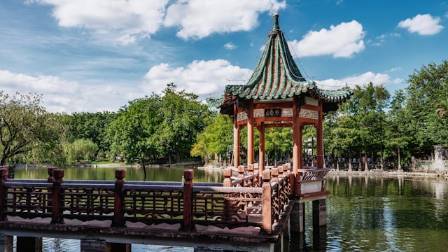
Without knowing much about the pavilion's background, it would probably be difficult to tell that the structure was originally created with a Japanese prince in mind. Its architecture combines elements associated with a traditional Japanese tea house with influences from Western architectural design.
The double-sided pavilion stands over the artificial lake on concrete supports. Its two sections are positioned so that they face away from one another at approximately 45-degree angles.
The structural framework was constructed from cast iron, while Taiwanese cypress was used for the interior and portions of the exterior. The roof is arguably the feature that gives the pavilion its strongest Japanese character, although it is noticeably different from the traditional Japanese roof forms that remain common in both Taiwan and Japan.
Each of the pavilion's four-sided sections is topped by a roof featuring a pronounced arched shape, giving the building a distinctive appearance from the water and surrounding paths.
A Photogenic Taichung Landmark
For photographers, the Mid-Lake Pavilion is one of the classic images associated with Taichung. Its position over the water makes it an appealing subject in daylight, while nighttime photography offers an entirely different atmosphere.
The pavilion is currently closed to visitors because restoration work is being carried out on its interior. Once the renovation is finished, it is expected to reopen to the public at some point in the future.
Visiting Taichung Park
If you find yourself in Taichung, visiting the beautiful Taichung Park is well worth considering. The park is conveniently located and can be reached with a short walk from Taichung Train Station.
The Mid-Lake Pavilion is particularly worth seeing. This more-than-century-old structure is one of the surviving landmarks from the Japanese colonial period and has been remarkably well preserved. If you have enough time while exploring the city, I highly recommend making a stop at the park.
I will return to Taichung Park in another article with a less favorable assessment, looking at some of the issues and historical concerns surrounding the site. If you are interested in hearing the more critical side of the story, stay tuned for the next installment.
COVER · en

10 Charming Sitting Poses That Elevate Your Photos
When it comes to portraits, how you sit can completely transform the vibe of your picture. Whether snapping casual shots with friends or working with a professional photographer, knowing a few versatile poses helps you look natural, stylish, and confident. From relaxed angles to playful twists, these sitting ideas will bring variety and creativity to your photo collection.
COVER · en

Best Off-Road Vehicles in 2026
The best off-road vehicles are designed to match different levels of driver experience, from casual weekend trail users to serious overlanding enthusiasts. A strong foundation is essential, and most capable models use rugged body-on-frame construction paired with advanced 4WD systems.
COVER · en

How 3D Printing Works and Why It Changes Everything
Specialized equipment generates solid physical objects straight from digital files using three-dimensional creation methods. Charles W. Hull pioneered this transformative process back in the nineteen-eighties when he built the very first fabricated component. Modern additive fabrication expanded rapidly after that historic breakthrough. Today this dynamic industry offers endless opportunities for global innovation.
COVER · en

Discover the Smallest Canid of the Desert World
Fennec foxes are the absolute smallest members of the entire canid family. These incredible animals live in the deep deserts and arid regions of Africa and Arabia. They possess extraordinarily large ears that capture the slightest sounds. These massive ears help them hunt very efficiently during the dark night hours.
COVER · en

Next-Generation Surface Metrology: The Evolution of Autonomous Spherometry
Advanced spherometers represent the pinnacle of precision instrumentation, engineered to quantify the microscopic curvature of spherical topographies. These systems have become indispensable in high-tech sectors such as aerospace optics, semiconductor lithography, and advanced material science, where sub-micron surface fidelity dictates mission-critical performance. By leveraging ultra-sensitive hardware and intelligent processing, modern spherometry platforms allow researchers to achieve unprecedented levels of quality control and surface characterization.
COVER · en

Identifying the Finest Fish and Chips: An Expert Guide
For residents of the United Kingdom, the combination of battered fried fish and thick-cut potato wedges has been a dietary cornerstone for over a century and a half. This iconic meal is viewed as both a convenient street-side snack and a comforting staple for family gatherings. The tradition began in London during the 1860s, credited to Joseph Malin, an immigrant who successfully paired these two components. The dish holds deep cultural significance; historically, it was one of the rare food items excluded from rationing during both World Wars, underscoring its importance to the British public.